Hadith =/= Genetics: On Misreading Modern Science into Scripture
Just because the hadith says "dominance", doesn't mean it refers to "genetic dominance". Let's learn to read scripture on its own terms

Background
(Mis)reading science into a hadith
The Prophet Muhammad ﷺ is reported to have said:
If a man's water dominates the woman’s water, then the child resembles the father; and if the woman's water dominates the man’s water, then the child resembles the mother.
This statement, found in different variants across authentic hadith collections (example 1, 2), raise a number of interesting issues worth parsing. (In fact, some friends and I are working on a long-form essay just on this one hadith—stay tuned.)
The hadith seems to suggest that the reason a child resembles one parent over the other is due to the way male and female “waters”—i.e., reproductive fluids—interact with each other. The mode of interaction is specified by the verb translated here as “dominates”, but the specific wording isn’t settled across variants. Most variants have the word سبق which means preceding, but also carries the connotation of outcompeting or dominating (e.g., see the usage in Qur’an, 56:60]; while a smaller number of variants mention على, literally “above”, which also connotes dominating or prevailing.
The fact that the hadith mentions “dominance” in the context of genetics is taken by some Muslims to think the reference here is to genetic dominance. For instance, Sh. Dr. Yasir Qadhi in his explanation of the hadith says the following:
This translation fits in absolutely perfectly with the modern concept of genetics. Because whichever of the genes “overpowers” the others, the child will be looking like that person. And in fact even in modern biology, ask any student of genetics, what is the word that is used? Dominant genes. This is سبق, this is what it is—dominant genes. [video, 16:20 onwards]
The shaykh then goes on to explain what genetic dominance means, and sums up the discussion by saying “this is exactly how we can understand the hadith”.
I think this approach is wrong. But before I explain why, let me state that this error is entirely understandable.
The problem of forcing everyday language into scientific categories
The fact that the word used in modern genetics is exactly the same as the word used in plausible translations of the hadith is definitely interesting—it struck me as interesting too—and from there it’s not hard to equate the two concepts. However, as we’ll see below, “genetic dominance” carries a very specific, technical meaning; while the wording used by the Prophet connotes dominance, prevalence, or outcompeting in a general, broad sense. This is obvious: the سبق or على are normal, everyday words that could refer to a wide range of relationships, while the term “genetic dominance” has come about in a specific scientific context and has its own utility. The semantic scope of the latter is much more restricted than the former.
Furthermore, contrary to Sh. Yasir’s comments above, of all the mechanisms that determine the resemblance between parent and child, genetic dominance is quite rare. (The reason this concept in genetics has so much cultural capital is because it’s the most convenient mode of inheritance to teach in high school biology.) So by restricting the meaning of the hadith to genetic dominance alone, we actually end up constructing a scientific conflict where there wasn’t any.
This is an example of a common hermeneutical error: conflating the semantic scope of commonly used words with those of recently coined technical terms.
Consider this analogy. In most human cultures, the word “fish” historically referred to whales as well. On the other hand, a taxonomist whose goal is to categorize organisms based on their deeper biological organizations, would scoff at such a suggestion—after all, whales are warm-blooded, don’t lay eggs, don’t have gills, and breathe with their lungs.
Say we come across an ancient text describing something that sounds very much like a whale: a massive, horizontally-tailed ocean fish that made water spouts through their blowholes. Upon consulting with the resident taxonomist, however, we quickly learn that while whales do meet that description, whales aren’t fish. We therefore conclude the event described in the ancient text must’ve been wrong. After all, no fish matching that description ever existed.
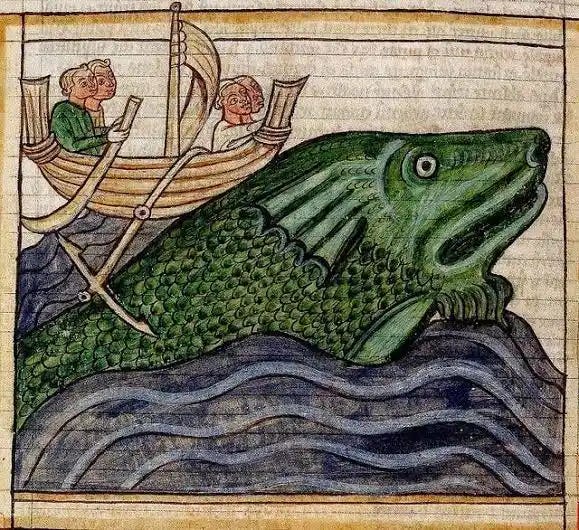
Clearly, that would be silly: it’s a category error to use such technical, utilitarian definitions to restrict common expressions. (This mistake is also seen when ancient descriptions of heavenly bodies are forcibly mapped on to modern scientific categorizations of planets, stars and meteors.)
Reading the hadith with fresh eyes
Let’s return to the hadith and the word “dominance”, both its colloquial and technical meanings. In what follows, I’ll describe what genetic dominance is, and survey all the different ways in which resemblance between child and a parent is determined. In the course of this exploration, we’ll realize that all such mechanisms of determining resemblance can be described as a vague, general notion of dominance (or overpowering, or outcompeting—take your pick).
Before that exercise, let’s look at the hadith one more time to see what natural phenomenon it’s meant to describe,
If a man’s water dominates the woman’s water, then the child resembles the father; and if the woman’s water dominates the man’s water, then the child resembles the mother.
In what follows, we’ll gloss “water” as “reproductive substance”—as in, the substance contributed by mother and father that’s responsible for heredity. We now know the identity of those substances (genes, or alleles if we’re talking about gene variants). In a later section of the article, we’ll discuss whether this water to allele gloss is fair.
Note first that the hadith isn’t about the general phenomenon of resemblance between parent and child. A child’s features often represent the midpoint between theparents, but in some cases, the child might resemble one parent more than the other. That’s what the hadith is talking about, so in what follows we’ll discuss the genetic mechanisms that cause a child to exhibit such a skew.
We start with the most familiar textbook case—the one Sh. Yasir immediately thought of in relation to the hadith.
Let there be science
Genetic dominance
I think intuition about genetics is most easily built by looking at concrete examples, and that’s what we’ll do here.
Consider lactose intolerance. Most humans cannot digest the lactose sugar found in milk, which leads to stomach problems in many of us. As it happens, everyone can digest lactose as infants, but the ability goes away when we grow up. This is because the enzyme responsible for breaking down the sugar stops being produced in our body. In other words, each of us possesses the molecular machinery required to digest milk, just that in most of us that machinery gets turned off after infancy.
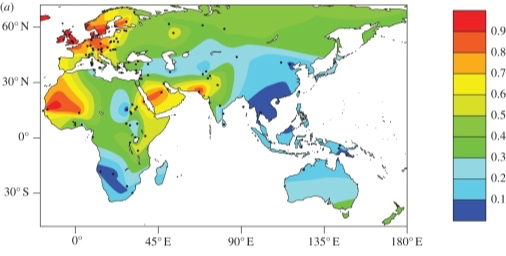
People in Northern Europe and some parts of Africa and the Middle East, however, have the ability to digest lactose even as adults. This happens because these individuals have genetic mutations in a region in the genome involved in regulating the production of the lactose-digesting enzyme—a “switch” for the machine, if you will. As a result, their lactose digesting-switch never turns off, even after growing up.
Before continuing with this story, we need a basic biology interlude.
All humans have 23 pairs of chromosomes, which can be conveniently understood as packets of DNA. The child receives one of each pair from each parent—one set from mother, one from father. The DNA contained within these chromosomes, taken together, comprise the human genome—the sum total of all genetic information required to specify our characteristics (phenotype).
Stretches of DNA within chromosomes—genes—specify different human characteristics or phenotype. For example, a gene on chromosome 15 produces a protein which determines the color of our eyes.
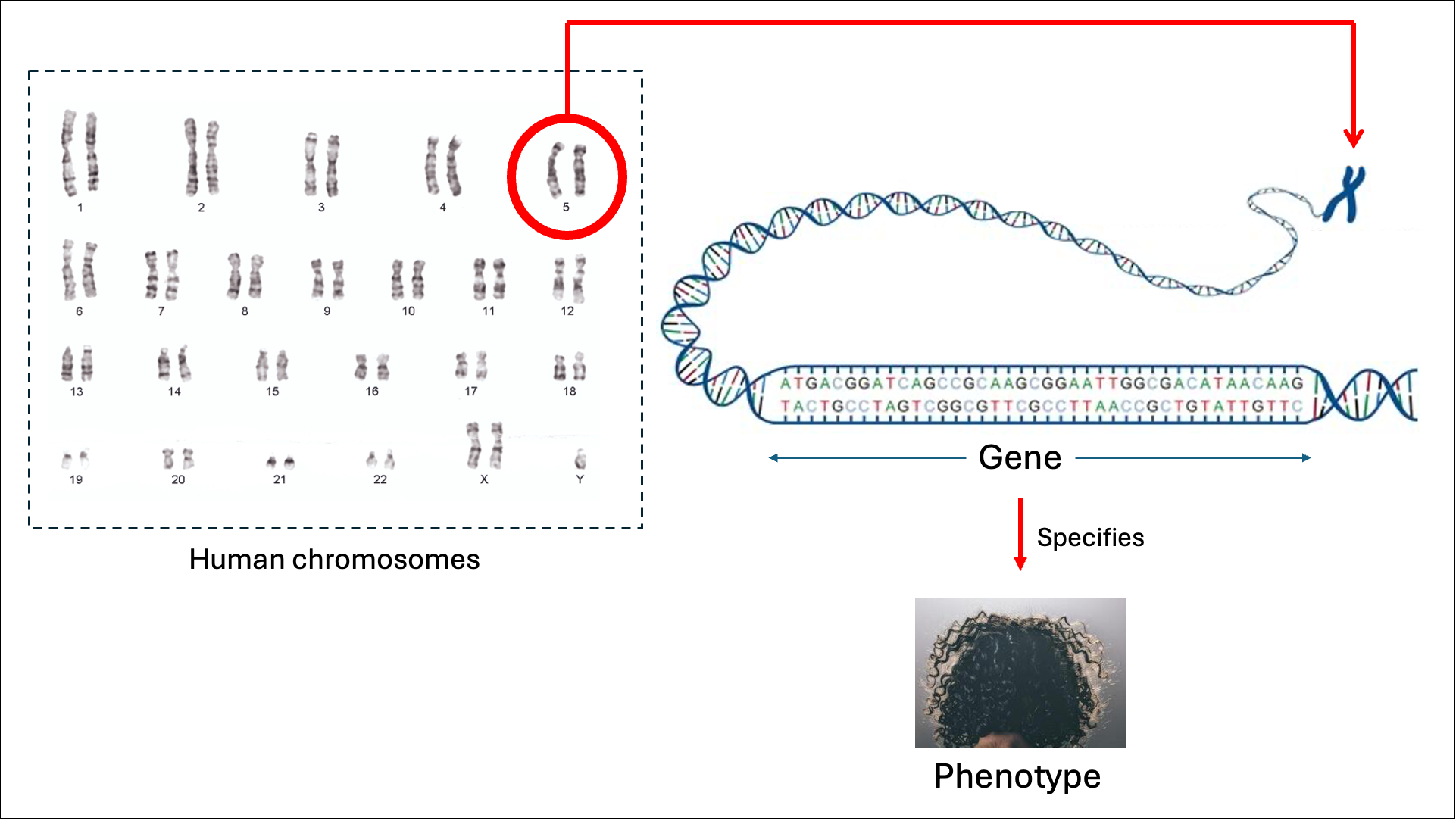
All humans largely receive the same set of genes from both parents, but some genes might differ in their sequences between the two parental copies. Each of these gene variants are referred to as alleles, and different alleles often have different functional consequences.

Now imagine a child with a European mother and an Indian father, who receives a lactose-digesting allele from mom and a “normal”, non-digesting allele from dad. Would this child be able to digest milk in adulthood or not?
Upon digestion, lactose generates two products—glucose and galactose—which are released into the bloodstream. This means we can measure the activity of the lactose-digesting enzyme in an individual by measuring their blood glucose following the ingestion of milk.
Someone with two European parents who can both digest lactose would have a high amount of blood glucose, while someone with only Indian parents would have very low activity. As it happens, our hypothetical child with a lactose tolerant-mother and a lactose intolerant-father only has an intermediate level of enzyme activity.
Interestingly, however, even such an intermediate level is enough to provide full lactose tolerance in an individual. In the final analysis, if a child inherits a lactose-digesting allele from one parent and a “nondigesting”-allele from another, their phenotype in regards to lactose tolerance will be determined by the former.
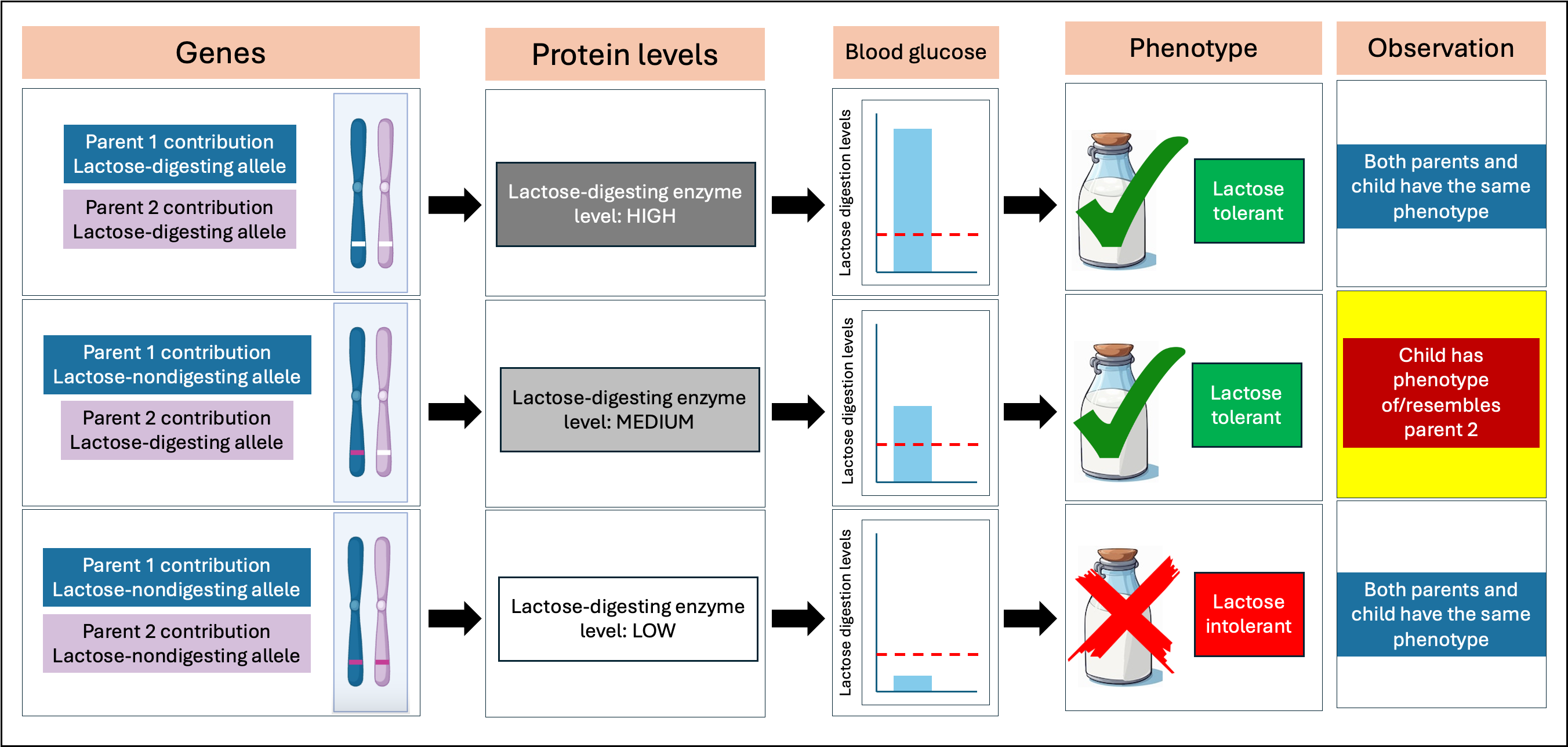
This phenomenon is captured by the metaphor of “dominance”: it’s as if the lactose-digesting allele “dominates” the effect of the other allele in determining the child’s characteristics. Or put another way, the child resembles the parent whose allele dominates.
Lactose tolerance is the textbook example of genetic dominance, and its easy to see why one would think this is the only phenomenon the hadith would be referring to. However, this is not the only reason a child resembles one parent more than the other.
Resemblance, but no genetic dominance
Consider a variation of the example in which one parent, say the father, has one lactose-digesting allele and one non-digesting allele, while both of the mother’s alleles are non-digesting. According to the schema described above, dad can digest lactose but mom can’t. Since just one of each parental allele gets passed on, the child has a 50% chance to end up inheriting a non-digesting allele from each of the parents. This would mean the child would have the exact same allele complement as the mother—two non-digesting ones, and therefore the same phenotype as well (see figure below).
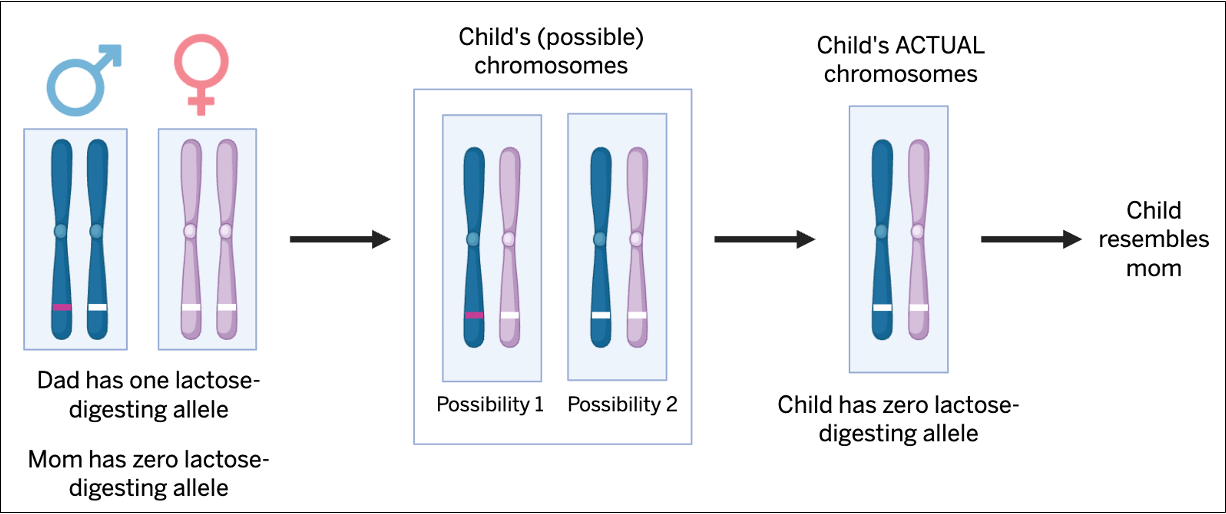
This is a case of the child resembling the mother and not the father, and yet genetic dominance isn’t at play here. In order to have dominance the child must have two different alleles, but in this case both alleles are the same (non-digesting).
However, if we step away from the technical definition and instead try to describe the interaction between maternal and paternal alleles in common language, it certainly wouldn’t be wrong to say that in this situation, the mother’s alleles or genotype prevailed. After all, the child ends up with the exact same allele-set as the mother, so her genotype “wins out”. Dominates, if you will.
How resemblance is usually determined: complex traits
Our extended example of lactose intolerance is the way people usually think about genetics, possibly because this is how we’re introduced to the concept in school. However, very little of human genetics works this way. For one, unlike our example, a trait is rarely determined by just one gene or allele, but rather via the aggregate action of many individual alleles. Perhaps the most well-studied example is height: different studies suggest that human height might be influenced by hundreds to thousands of different alleles (see this article for a review).
Secondly, lactose tolerance is what we call a binary trait: either you can tolerate milk or or you can’t; but clearly, most human variation can’t be described this way. There’s no threshold, for instance, to what’s considered short or tall—the trait varies on a spectrum. Relatedly, the vast majority of our alleles don’t interact according to such strict dominance: in fact, if mom and dad passes on alleles of contrasting effects, the child’s phenotype falls near the midpoint. Large-scale analyses of human genetics datasets consistently suggest that dominance is a rare phenomenon (this study, for example, identified dominance interaction for a little less than one-fifth of the total alleles considered).
All of this reinforces our earlier point: genetic dominance is textbook, but not common; so it’s definitely problematic to pigeonhole the hadith’s semantic scope in this way.
So how else does a child resemble one parent over the other? Let’s go back to height: as mentioned above, human height might be determined by as many as thousands of different genes acting together, each having a small to moderate effect. In case of such complex traits, the genetic component of the child’s height would be determined (i.e., if we leave environmental effects to one side) by the number of height-affecting alleles they have, multiplied by the effect contributed by each. Some alleles boost height, some heights decrease it, and the child reflects the aggregate.
In such a system, how might a child resemble one parent over the other? If the taller parent passes on more height-increasing alleles than the other, they would cumulatively manifest in the child being taller (and thereby resembling the tall parent).
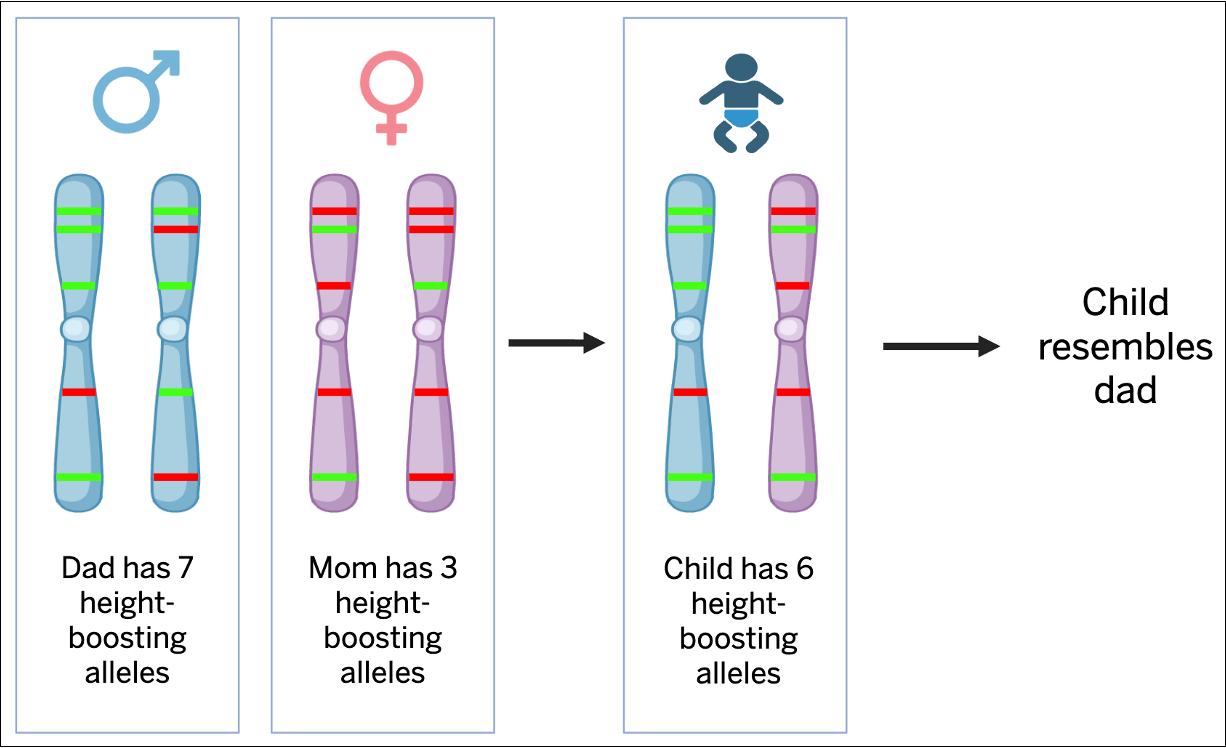
Again, this effect cannot be called “dominance” in the way the word is used in genetics—none of the alleles are competing with their counterparts.
Note again, however, in this case we can easily describe the phenomenon as the dad’s alleles “dominating” over the mom’s: the child’s genome is flooded with height-boosting alleles that they got from the tall dad. The dominance language expresses the higher number of one parent’s alleles than the other.
It’s dominance, all the way across
There are other, more uncommon ways in which a child might resemble one parent more—for instance, between the two parental alleles, only one might be expressed while the other is silenced, a phenomenon referred to as “imprinting”. While this is also not a case of genetic dominance, here too the language of dominance expresses the fact that the non-silenced parent’s alleles are dominating.
In summary, the myriad ways in which a child resembles one parent more than other can all be captured in the word dominance, or prevalence, or outcompeting. Whether via strict genetic dominance, the manifestation of one parent’s genotype, the higher number of alleles inherited from one parent than the other, or one parent’s allele getting silenced—as a commonly used catch-all term, one parent’s reproductive substance “dominating” is pretty good.

A further note on descriptions of natural phenomena in scripture
According to the hadith, the reason one child resembles dad and not mom (or vice versa) is because of the way their reproductive substances interact. As our survey above shows, the various complex interactions between male and female alleles can be appropriately described as one somehow being dominant over the other. Given how general the language of the hadith is, it successfully evades the charge of any scientific error.
This leaves one residual issue.
Sure, we can buy that the Prophet’s answer doesn’t contradict science, but maybe this was not the best answer to the question. The hadith reduces an extremely complex, multifaceted phenomenon to a general form of dominance, not to mention equating between alleles and “water”. However, whether this impression is correct depends on what the Prophet was tasked to do in the first place.
The Prophet was an emissary of the Omniscient God, and in the same hadith he goes on to say that he was informed of these details via Divine Revelation. It’s certainly not beyond the powers of God to reveal as much scientific detail as He wished. However, the Prophet’s task is not to provide scientifically informative answers, but to speak in a way that would accommodate the phenomenology of the audience. This phenomenon is referred to as Divine Accommodation—roughly, the idea that God speaks in a way that’s sensible and useful to the audience (as long as it doesn’t contain straight-out falsehoods, of course).
The mode of God’s language about natural phenomena is a fascinating topic in its own right, but for our purposes let’s briefly note the context of the hadith itself. The hadith is part of a longer conversation between the Prophet and an inquisitive Rabbi who, as a test for the Prophet’s truthfulness, is quizzing him about knowledge of Jewish scripture. To satisfy this questioner, the Prophet must provide not just any scientifically accurate account of parent-child resemblance, but the specific statement the Rabbi expects—the one that’s found in the Jewish sources.
Since the Rabbi is satisfied by the Prophet’s response, we understand that the answer did echo some pre-existing Divinely revealed piece of scripture that the Rabbi was familiar with. As such, taking the hadith at face value, the right question isn’t why the Prophet described the phenomenon in this way; but rather, why God chose to reveal this detail to the Jews in the first place. We have no way of knowing the answer to that question, but we can surmise that there was little benefit in providing gratuitous scientific details to that audience either.
Once we fix these constraints of expression, it’s hard to see how else the phenomenon could’ve been described other than the words found in the hadith. Let’s pick up the equivocation between “alleles” and “water” and consider how else the Prophet—or God before him, when He spoke to the Jews—could’ve explained it. Sure, God could’ve described genes and alleles in all their gory details, but that wouldn’t accommodate the audience’s phenomenology (not to mention, what spiritual benefit would that level of detail have?).
But perhaps there a way of referring to genes without describing them in detail. For a long time prior to the discovery of genes, thinkers used abstract concepts to indicate the reproductive substance. Mendel, for instance, used the word “factor” as a placeholder for the substance that acts as units of heredity, without knowing anything about the nature of that substance. However, speaking in terms of such abstract notions would also similarly confuse the audience.
If one can’t describe alleles in details, and has to use concrete referents only—no abstract placeholders—“water” really is the best one can do (the rest of the hadith describes the water’s color and consistency, meaning the more accurate translation is “fluids”). After all, the alleles (which are on chromosomes) reside within sperm and egg cells, themselves carried in a suspension of reproductive fluids. Interestingly, the Prophet does elsewhere acknowledge that it’s not the fluid itself, but an unspecified part thereof that’s relevant to heredity.